Gandhinagar, 4 June 2025: The Gujarat Council of School
Education–Samagra Shiksha (GCSE-SS) is advancing NEP 2020 by promoting digital
literacy and 21st-century skills in public education through the MyCode
project, where 470 Master Trainers have equipped 8,652 government school
educators with future-ready pedagogies, reaching over 3,83,636 learners across Gujarat.
Since 2022, MyCode, a collaborative
initiative by GCSE-SS, Capgemini, and Quest Alliance, has introduced
computational thinking (CT) in government schools, enabling students,
especially from digitally underserved communities in Ahmedabad, Bahashantha, Kheda,
Anand, and other districts, to engage in STEM clubs, ideathons, hackathons, and
career exploration sessions. The program, running in 8,810 schools across 13
districts, has driven a shift in pedagogy by equipping educators to use
technology and foster discussions around self, gender, and well-being, helping
build STEM mindsets.
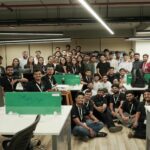
Mycode culminated in February this
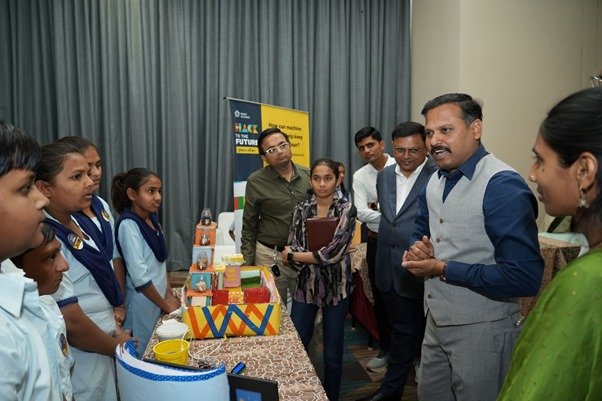
year, with the Hack to the Future (HttF) inter-school hackathon held in
Gandhinagar. The event featured 15 student prototypes, like a Fire Fighting
Robot that detects fires and activates a foam suppression system, and a Smart
Farming System that uses IR sensors to detect animal intrusions and protect
crops with solar-powered lights that the learners built with the help of their
educators. A standout project was a women’s safety device designed by Anjaliben
Ambalal Vanzara, a Class 7 student from Chhipadi Kanya Shala, Kheda district.
The device fitted with a panic button alerts the nearest police station in
emergencies. “We created this device after recognizing the challenges girls
face due to safety concerns, which often lead to school dropouts or restricted
mobility,” Anjaliben shared.
HttF also created an opportunity for
learners and educators to interact with Shri. Ranjeeth Kumar J, IAS, the State
Project Director of GCSE-SS. He noted that “NEP 2020 has encouraged
computational thinking, problem-solving, and critical reasoning as foundational
competencies for 21st-century learners. HttF is a testament to fostering
innovation, technological empowerment, and STEM excellence within public
education. By championing such interventions, the government is accelerating
the adoption of computational literacy and ensuring that learners, particularly
from underserved communities, are equipped with critical thinking and digital
fluency to thrive in the future workplace.”
Anurag
Pratap, Vice President and CSR Leader, India, Capgemini,
said, “This initiative aims to equip learners with essential tech skills
while providing a collaborative platform to explore solutions for climate
resilience, gender equity, safer living environments, and overall well-being.
Through hackathons, students engage in hands-on learning, applying programming,
design thinking, and technology to address real-world challenges.”
The initiative has brought about
notable change among learners in the past six months, where 48% reported using
AI tools, 53% used technology for learning, 71% worked with Scratch
programming, and 68% participated in hackathons.
Neha Parti, Director-Schools, Quest Alliance, said, “Our approach to ideathons and hackathons is designed to nurture problem-solving and creativity among learners. Through these experiences, students gain the confidence and skills to develop impactful solutions for themselves and their communities. By using technology, they materialize envisioned solutions to real-world problems.”
A recent evaluation of the program’s impact across 25 schools in Ahmedabad, Kheda, Gandhinagar, Chhota Udepur, and Aravalli found that 77% of educators supported continuing the program, citing improvements in computational thinking and digital literacy among both learners and educators. Over half the educators reported enhanced student outcomes in critical thinking, innovation, interest in STEM, and overall performance since its implementation. The next phase of the program will develop a digital training module for teachers to facilitate ideathons and hackathons, fostering critical thinking and problem-solving among learners.